

Agreements
Each one has its own rule profile.
- Employees' agreement
- Supervisors' agreement
Scheduling
Shift rosterPlan to the rhythm of salesAutomatic shiftsA ready draft in secondsShift offersOpen shifts out to the teamStaffing needsSay how many you need and when
MaRa agreement · depth of support
Agreements
Employees’ agreement · Supervisors’ agreement
Employment
Full-time · Part-time · Variable hours
Working-time forms
Weekly hours · Period work, 3 weeks · Night work · Equivalent to three-shift work
Calculation and monitoring
Rest periods · Additional work and overtime · Evening and night allowances · Midweek holidays · Standby · Annual leave · Local agreements

From a customer
“The best thing the industry has seen.”
Erkka · Ravintolamestarit
Episodes
What is MaRa TES and does it apply to me?Episode 2 · video 3:51Finnish labour rules in 5 minutes: law, TES and your contractEpisode 1 · video 2:52Shift roster rules in Finland: notice, rest and changesEpisode 15 · video 2:39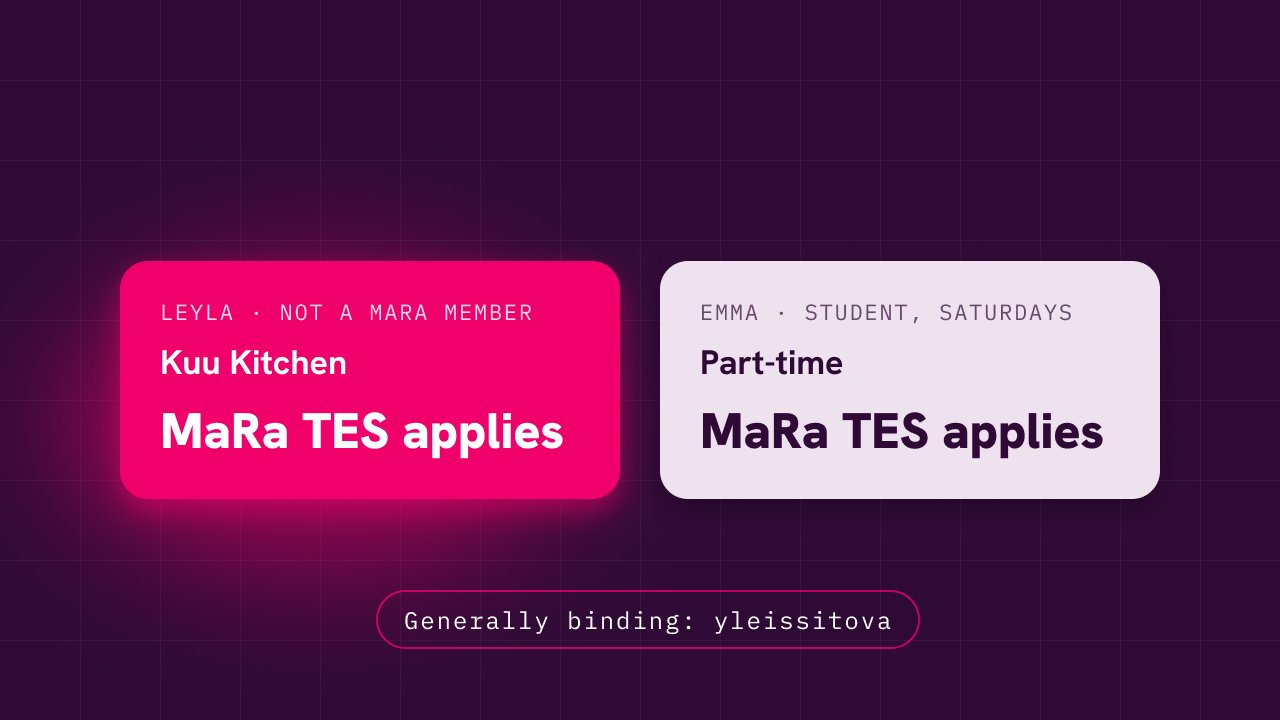
Sutja knows the collective agreements for the tourism, restaurant and leisure services sector. Rotas, employment contracts, leave and HR records stay in line with them: premiums are calculated for you and rest periods stay where they belong.
209
coded rules from the MaRa agreements for employees and supervisors. Each one has a value, a clause and a verification status.
Agreements for employees and supervisors · both universally binding · valid until 31 March 2028
A rota tool that only knows rest periods leaves the rest in your head. Sutja applies the agreement as it is written, for supervisors and period-based work too.
Each one has its own rule profile.
Part-time and variable working hours follow their own rules.
Period hour caps and reductions follow the arrangement in use.
A violation blocks publishing before the error reaches payroll.
Every shift is checked against the MaRa agreement and the Working Hours Act while you plan. When you publish, Sutja tells you whose days off are left ungiven and suggests the fix with the clause.
Actual hours, the overtime threshold, days off and the working-day rhythm are shown for each person while you build shifts. The annual leave balance and skills are in the same view.
When a shift cuts into weekly rest, publishing needs an exception permit. The supervisor records the reason and can offer compensatory rest, and the employee is notified. Statutory limits cannot be overridden.
The employment contract states which MaRa agreement applies to the person. Sutja calculates shifts, premiums and leave accordingly, and the default comes from the workspace settings.
Sutja lists every coded rule: its value, its clause, what it does, and whether the number comes from the agreement text or from the law. A lawyer or shop steward can check all of it.
| Rule | Value | Clause | Status |
|---|---|---|---|
| Daily rest | 11 h | MaRa 7.4 § / TAL 25 § | Confirmed |
| Minimum agreed rest | 8 h | MaRa 7.4 § | Confirmed |
| Rest between long shifts | 10 h shift → 11 h | MaRa 7.4 § | Confirmed |
| Weekly rest | 30 h | MaRa 8.2 § | Confirmed |
| Maximum daily working time | 10 h | MaRa 7.3 § | Confirmed |
The count includes every coded form: the rules for employees and supervisors, the alternatives for locally agreed rules and the balancing system forms.
In the app, the full rulebook with values and clauses is in the collective agreement settings.
Sutja won't suggest shifts that break rest periods or maximum working hours.
Evening, night, Sunday and public holiday premiums are calculated for every shift.
Labour costs and the upcoming payroll total are visible while you plan.
Rules are fine-tuned to your workplace's agreements, and deviations are shown before publishing.
Short answers to the most common questions about the collective agreement for the tourism, restaurant and leisure sector. The exact provisions are in the agreement text. Anything left open? Ask us.
The MaRa agreement is the collective agreement for the tourism, restaurant and leisure sector in Finland. It is concluded by the Finnish Hospitality Association MaRa and the Service Union United PAM. It sets the sector’s rules on working hours, rest periods, pay premiums, annual leave and other terms of employment.
It applies in restaurants, cafés, hotels and other accommodation, food service and leisure businesses. It is generally binding, so companies that are not members of the employers’ association must follow it too. Supervisors have their own collective agreement, which is also generally binding.
Regular working time is 37.5 hours a week on average. In period-based work it balances out to 112.5 hours over a three-week period. Regular daily working time is at most 10 hours, and a shift is as a rule at least 4 hours.
The shift roster is given out no later than a week before the period starts. Changes to a published roster are agreed with the employee. Steps, rules and a template are in the guide how to make a shift roster.
Daily rest is 11 hours. It can be agreed shorter, but not below 8 hours, and there are always 11 hours between shifts of 10 hours or more. Every week also includes weekly rest.
In period-based work, each five-day working week earns two days off, so a three-week period has at least six. At least two of them must be in a row, and at least every fifth weekend is given off.
The agreement sets premiums for evening and night work, the increase for work on holiday eves, the increases for work on days off and the compensation for additional work and overtime. Work on Sundays and church holidays is paid at double the normal rate. There is no separate Saturday premium. The amounts and time windows are in the agreement text and in Sutja’s rulebook.
Annual leave accrues at 2 or 2.5 days a month under the Annual Holidays Act. Public holidays do not shorten the period’s working time; instead, annual free time accrues from hours worked. The holiday bonus is 50 per cent of holiday pay, paid when the leave starts as agreed and the employee returns to work right after it.
Sutja checks every shift against the MaRa agreement and the Working Hours Act while you plan, calculates premiums for each shift and tells you before publishing if a rest period, day off or hour limit is not met. Every coded rule with its section is in the rulebook above.
Fill in the form and watch the one-minute product demo right away, at your own pace and without a sales call.
Hiillos Kluuvi · Wed 28 Oct
SalesShow as table
€3,985.10 incl. VATWed 29 Oct 2025 · week 44
13:00–14:00685,90 €
Source: sales data file · updated 20 Oct 2026